
ATTIVO
What really matters: Exploring The World With Bettany Hughes
Lysanne Currie
Renowned historian Bettany Hughes tells Attivo Life Magazine why understanding a destination’s history can be so crucial for self-discovery.
There’s a scene in the first episode of Bettany Hughes’s latest two-parter, Exploring India’s Treasures (watch now on All4), which provides an emotional pause for thought. The show, described as ‘an adventure of a lifetime to discover the greatest archaeological, architectural and cultural treasures of the Indian sub-continent’, sees Bettany begin her adventure in Varanasi, the city on the Ganges famous for its role in the traditions of pilgrimage, death and mourning. She wanted to ‘try to explore how our understanding of the cycle of life and our desire to flourish in this world and the next has generated some extraordinary treasures and some extraordinary experiences’.
Bettany attends the Pind Daan, a post-death ceremony for her mother, who passed away unexpectedly before the trip. The ritual sees the bereaved take an offering of rice balls and flowers to the river.
Though she was already familiar with the ritual, the priest’s words about departed souls returning to the universe resonated strongly with Bettany: ‘Whatever you think spiritually, we know, scientifically, that this is what happens: atoms don’t evaporate, they just become something else. We all become parts of other organisms in life.’ She recalls the contrasting emotions of the moment, saying: ‘I looked up, and my crew had tears streaming down their faces. As I placed the garland for my mum in the river, a kid did a backflip into the water. I just thought, “Well, there it is: the cycle of life.”’
History brought to life
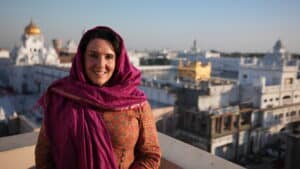
Historian, author and broadcaster Bettany Hughes has been helping us understand history through our screens for almost three decades. She says: ‘When I started, people said, “Nobody’s interested in history. Nobody watches history programmes on television. Nobody wants to be lectured to by a woman.”’ Some 450 million viewers later, and with her shows screened in 120 countries worldwide to fans of all ages, globetrotting historian Bettany Hughes has gently, charmingly and firmly proved the naysayers wrong.
Programmes range from A Greek Odyssey to Secrets of Pompeii: Greatest Treasures. In From Paris to Rome, Bettany follows in the footsteps of 18th-century aristocrats on a Grand Tour to discover how travel can enrich our lives. Through them all, her talent for storytelling engrosses and educates her viewers.
Bettany’s career started after she was inspired over 30 years ago by a programme on British television about Tutankhamun. ‘I still remember the frisson – the realisation that the stories I’d heard, of boy-kings dripping in gold, of hidden burial chambers and court intrigue could, sometimes, be true. That BBC documentary was inspirational.’
“There’s no point just skimming through life. You need to really appreciate it and appreciate the moment.”
Bettany is fascinated by discovering connections in far-flung places, uncovering the interplay of different cultures, and how borders and boundaries collapse through time, and India was no exception. ‘India is a place where ideas are made manifest,’ she says. ‘Because there’ve been so many different influences there, you’ve got this incredible reservoir of inspiration. Socrates’ ideas, for example, are very similar to Buddha’s 2,500 years ago. And Christian monks almost certainly got their ideas from Buddhist monks along the Silk Road.’
This series, she says, was her reaction to lockdown: ‘My team can’t invent a vaccine. We can’t organise food supplies or deliver to hospitals, but we can show people there’s still a beautiful world out there. There’ve been so many terrible things that have happened in the story of the world, but when we can, we get up, dust ourselves down, and carry on. So it felt very important to do this. But we weren’t sure whether it would fly as an idea.’ Luckily, a ‘fantastic’ Channel 4 commissioner, Shaminder Nahal, ‘who’s as passionate about India as I am’, gave it the green light.
“There’ve been so many terrible things that have happened in the story of the world, but when we can, we get up, dust ourselves down, and carry on.”
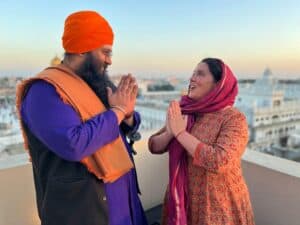
Still, Bettany knew they had to be careful: ‘I didn’t want to be another white presenter looking at India – which has happened a lot in the story of television.’ Always, permissions were asked, ‘and I have to say, without exception, we were made so welcome. [For our trip to] Amritsar, which has a very difficult past, historically, with Britain, we were told, [yes], “as long as you come with the right intention.”
Undiscovered territory
Bettany has just returned from Estonian – among those places, such as Albania, Bulgaria and Azerbaijan, that ‘people wouldn’t automatically think, ‘oh, I need to sit and watch an hour about this’. And yet the Albania programme, from the previous series, scored her highest ratings of all. This could perhaps be attributed to the country’s release from years-long communist rule, with a reported 100 per cent increase in visitors – especially from the UK – in the last year alone.
‘When we were in Estonia, we were on this amazing island called Kihnu, which is run by women, who are very powerful and self-sufficient because it’s in the middle of the Baltic Sea,’ she recalls. ‘The men from the island leave for up to nine months of the year to be sailors. So the women have always had to manage things on shore. When they reach menopause, and their children have grown up, they have the time and liberty to be themselves. Up until that point, they’d been keeping the community going. It’s almost like a ritual; you are given the status of a “wise woman”. And the idea is that this is now your moment to have the liberty to do whatever you want to do.’
The day we talk, Bettany is getting ready for her next journey – to a remote village on the borders of Azerbaijan and Russia, to a Zoroastrian fire temple. To really get under the skin of places like these, she says, you have to earn people’s trust. It’s a respectful approach that forces her to find the fundamental basic human connection between yourself and others when you often don’t have a common language. Socialising with people with very different life experiences and worldviews is just a huge privilege.
“Neuroscientists tell us we carry memories across our brains. We can’t have a future thought unless we access a memory so immersing yourself in memory makes you think better, bigger, and have newer ideas for the future.”
She says travel is so key to telling us stories and making connections. She can’t write about history unless she travels to the place where it happened. ‘You’re not just an armchair historian; you’re physically experiencing it. And as you travel through, you imagine the experiences of others who’ve gone before.’
It’s a wisdom-gathering exercise, too. “Neuroscientists tell us we carry memories right across our brains. We can’t have a future thought unless we access a memory of some kind. So, immersing yourself in memory makes you think better, bigger, and have newer ideas for the future, which is an incredibly positive thing. Swimming in these historical and cultural environments isn’t being nostalgic or backwards-looking – it’s the opposite.’
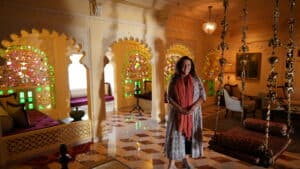
Of course, recent history has had other knock-ons: ‘I think we’ve fundamentally realised there’s no point just skimming through life. You need to really appreciate it and appreciate the moment. I remember those first few months of the pandemic, when people were looking at trees in their street, or listening to birdsong, as if for the first time.
‘And I think that’s continuing how people travel and explore a culture. I have had so many conversations with ministers of culture and tourism around the world, who tell me it’s the most extraordinary opportunity for the next generation to be totally invested in the history and culture of their place, not to mention a massive economic opportunity for them. It’s a win-win both ways. And that’s fantastic.’
Exploring India’s Treasures is on All4 now.
If you enjoyed reading Bettany’s story, take a look at our interview Jason Fox, Jenny Agutter OBE and Lynne Franks and see how they are making a difference, too.
Prepare for your next phase of life
If you’d like to bring your vision for the future to life, why not talk to Attivo about our unique Lifestyle Financial Planning and how we can help you with the next stage. Click here to contact us.