
ATTIVO
The nomadic life
With eight in 10 of us signed up for hybrid work, the over 50s are the second group likely to pack up their laptops and opt to log on in a different time zone. But what is life like for a digital nomad? And what tech do you need? Piers Martin investigates…
Picture the scene: you finish your last online meeting of the day. Do you: a) get on the Tube or dual carriageway and struggle home in the rain, or b) step out on to warm sand and settle down on the beach to enjoy the sunset. For many it’s a no-brainer – and far from a fantasy. With more than 35 million digital nomads worldwide as of 2022, radically reshaping our working lives is a post-pandemic trend that continues to grow.
While 46% of digital nomads are self-employed, 35% are employed by a company and this new work army contributes a global economic value of $787bn per year. Mexico is the most popular digital nomad destination in the world right now, with Thailand the second. But for Agata Nowicka, a business development consultant, work nirvana lies on the Indonesian island of Siberut. She’s spent the past seven years travelling the world – mainly in Indonesia and Australia – while holding down regular freelance work for a range of international clients.
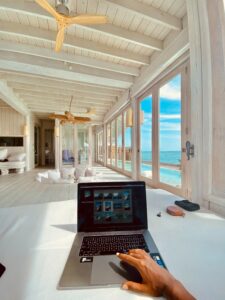
Initially based in London, Nowicka became a digital nomad – like numerous Westerners – because she was unhappy with her life back home. “People said, ‘Oh you’re so brave’. But I was miserable and desperate to change something, and this nomadic life was perfect for me,” she says over a video call from the island.
“The truth is, I don’t have that many responsibilities and commitments in life, so that makes things easier. I feel free.” When she first set off in 2015 to Central America armed with a laptop and a phone full of data – encouraged by her sympathetic boss at their digital start-up – Nowicka was something of a trendsetter.
Today the digital nomad lifestyle is booming as remote working post-Covid becomes the norm, and many companies realise their workers no longer need to be in the office every day and can deliver the goods from anywhere in the world.
Half of digital nomads come from North America and the rest from Europe and Russia, with the biggest demographic being 30-somethings. But it’s not just software developers, marketing professionals and start-up entrepreneurs who are flocking to sunnier or more relaxed climes. Company executives and seasoned financiers are also realising that life doesn’t have to be a daily grind, with the second biggest group now those in their 50s, as they opt to change location rather than job at what is often a key time of re-evaluation in a career.
Today the digital nomad lifestyle is booming as remote working post-Covid becomes the norm.
The question for all though is the same: why suffer the daily commute when you could be doing the same job in Lisbon, Medellin, Chiang Mai or Bali, among communities of like-minded travellers?

The right kit
Tech matters. You need your essentials:
A reliable laptop, a couple of phones, local sim cards, rechargeable battery packs, plus a relatively healthy bank balance and means of income, not to mention an understanding of, and compliance with, each country’s digital nomad visa regulations, and you’ll be able to pack in the nine-to-five in a bid to live the dream by working remotely in exotic locations.
“As long as I have my laptop, good wifi and local sim cards with lots of data, I’m fine,” says Nowicka. “The worst place was travelling the South Island of New Zealand – it was a big problem picking a place with either good wifi or 4G.”
For security expert James Bore, of London’s Bores consultancy, the main issue faced by nomads – aside from local power outages and signal failure – is using public wifi, often in a café or bar, for confidential company work. He points to the case of an organised crime group who compromised wireless networks in luxury hotels to capture the business data of the executives staying there by intercepting their communications.

To combat this, he advises using a VPN (virtual private network), ‘an application you install which allows you to have a private connection between you and another endpoint, usually your company’. It’s best to pay for a secure provider such as Surfshark, ExpressVPN or CyberGhost rather than risk compromising your data via a free VPN.
“Remember, if it’s free, you’re the product,” Bore adds. To tackle power outages or to provide power in off-grid locations, Bore uses ‘cheap, solar-powered, rechargeable battery packs from Amazon’, which would give him three days of power. He carries what he needs in a backpack or, for longer expeditions, a flight case.
Other troubleshooting tips tend to be learned the hard way. The constant humidity in the tropics, especially Indonesia, can damage laptops, and when your MacBook or Chromebook is the one tool you need to do your job, you should protect it.
“MacBooks absorb the humidity and so I’ve had to put my laptop in a bag of rice every single night if I want it to work the next day,” Nowicka says. “If you work close to the beach, the salt and humidity can easily break your device.”
Work anywhere? Yes please
The rise in remote working has forced many firms to rethink not only how their office functions but also how they can get the most out of their employees who no longer wish to be physically present. For Grace Francis, global chief creative of design and processing at media company Wongdoody, the trend started in the pandemic. “People needed to go to places they felt secure. We saw adults with partners and children going back to their parents across Europe, across the world. People returned to their roots, which extends to life after Covid as well.
“The other thing we’re seeing now is people wanting a little bit of luxury, such as going to an island for three months to avoid winter,” Francis says. “What we’re seeing is people testing the water or wanting to experiment. Whether it’s pragmatic or a frivolous desire, there’s no reason that someone can’t work somewhere else.”
Wongdoody’s 21 studios around the world mean hopping between continents can be relatively straightforward for employees. “Every now and then we have someone who has great ambitions,” Francis says.
“Whether it’s pragmatic or a frivolous desire, there’s no reason that someone can’t work somewhere else.”
“I’m working with a staff member in Australia at the moment who knows she wants to get to Europe and then keep going. She’s a wonderful designer who doesn’t have a set path and I’m trying to work it out with her.”
Do some workers get jealous when they see colleagues Zooming in from the beach or a snowy hillside? “I’d say there’s a degree of inspiration in seeing other people doing that and knowing it’s possible,” Francis says. “Sometimes it’s enough to dream, isn’t it?”
That dream surly has to end at some point, though – or does it? A recent survey by MBO Partners found that a third of digital nomads plan to nomad for a year or less, while 54 per cent planned to travel for at least two years. For the more committed, such as Nowicka, being free and flexible for so long comes at a price. “My problem is that I cannot settle. I do realise it. I actually want to find my base now, I feel I’m ready,” she says, adding she’s focusing her attention on the surfing mecca of the Mentawai Islands, where she spent the pandemic. “I just need to make a decision.”
Nomad hit list
These are the top six destinations according to Nomad List – added to which, Spain’s digital nomad visa has just been introduced (December 2022).
The visa follows Italy, Iceland, Romania and UAE in allowing employees of overseas companies to live and work in Spain without obtaining sponsorship from a Spanish employer. The law makes distinctions between regular employees and independent professionals.
- Mexico City, Mexico
- Chiang Mai, Thailand

Chiang Mai, Thailand - Lisbon, Portugal
- Canggu, Bali, Indonesia
- Madeira, Portugal
- Buenos Aires, Argentina

Buenos Aires, Argentina
For advice on your finances, contact your Attivo advisor or find us at Attivo.co.uk, we are here to help.