
ATTIVO
Survival Of The Fittest
By Louise Burke
The elite professional sporting world is seeing more athletes prolong their careers with the latest fitness and nutritional know-how. Here’s how to up your fitness game in later years…
As Oscar Wilde once said, ‘With age comes wisdom’. Now it appears it can also bring a record-breaking achievement if you happen to be a professional sports star. Some of the world’s most successful players are reaching the peak of their careers later than ever before.
A prime example of the seemingly eternal youthfulness of some sports stars is England’s most prolific fast bowler James (Jimmy) Anderson. At 41, Anderson has only got better with age. The ‘King of Swing’ played his 10th Ashes series this year, and despite speculation about his retirement, has yet to confirm if this was his last. And yet pundits claim his 85mph bowling skill is better than it’s ever been. He has reached legendary status – he has played 183 Tests for England and taken 690 wickets, the most of any fast bowler.

Professional sports, ultra-marathons and endurance cycling are no longer just a young man’s pursuit – and this goes for women too. Serena Williams was playing into her 40s until her retirement in September 2022, Tom Brady won a seventh Super Bowl at 43.
After winning his 20th grand slam singles title at 36, Roger Federer kept competing until retiring at 41, while Johan Clarey won an alpine skiing silver medal in Beijing at the record age of 41. Former London courier turned record-breaking cyclist Emily Chappell, now 41, became the fastest British woman to compete in the Transcontinental Race in 2016.
But what is the secret of their continued prolonged physical success? We speak to the professionals behind the scenes who are finding scientific pathways to longer health spans and optimal fitness.
The expert trainer
Scientific evidence shows muscle mass declines from our 30s onwards, leading to a slower metabolism, weakness and poor mobility. For both elite athletes and us mere mortals, this is where the experts come in. Running 5k three times a week to maintain cardiovascular fitness is not a bad thing but not necessarily as we age. Not for the pros anyway. The trainer’s approach is scientific and targeted to performance needs and to assess every stride and strain with GPS units, high-tech motion analysis systems and pressure plates.
In Anderson’s case, his body has been honed for the physical brutality of fast bowling since the age of eight. His strength and conditioning coach Phil Scott told The Times recently: ‘We know that older athletes have a higher susceptibility to calf strains due to changes in the muscle.’
Isometric exercises are practised to isolate the body’s muscle groups and hold positions for a period of time to strengthen the muscles. Strengthening exercises over a long time span is proven to increase longevity.
In the run up to the Ashes, Scott pushed Anderson to do aerobic sessions two or three times a week to take his heart rate up to at least 90 per cent of its max for five or ten minutes.
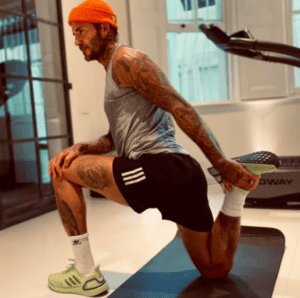
As well as building muscle, the trainers have also identified a need for exercises that help prevent injuring muscles and joints. Pilates-based exercises have weaved their way into the weekly workouts of David Beckham, pictured below, LeBron James and even Tiger Woods to create a stronger core.
Louise Buttler, founder of Live Brave Pilates, an online pilates platform, and also the wife of England Cricket Captain Jos Buttler, told Attivo Life Magazine, ‘Pilates works the smaller intrinsic muscles which are often neglected at the gym or when playing high-impact sports.
But these are crucial in supporting the global muscles as they help joints and ligaments work more efficiently and effectively – key for injury prevention and recovery. Pilates works the deep core muscles that are the foundation for everything, guaranteeing that the spine is supported in every movement, so the player can avoid back pain and perform to a high standard over a longer period of time.’
“Pilates is a low-impact sport to complement a more rigorous training regime.”
‘Online classes mean athletes can practise on the road but it also means it’s accessible to all with many platforms offering free trials to beginners,’ says Buttler. ‘If you practise three times a week, you will notice a difference in muscle tone and definition within a few weeks.’
The nutrition experts
Much more attention is now paid to not just what we eat but how much we eat of what and when. Unique meal plans are structured not just around the sportsperson’s performance, but also based on results of various tests of body fat composition and metabolic rates as well as nationality and if playing in a team, their position.
A steady amount of fuelling aids performance – and that includes a high amount of carbohydrates too (albeit more on days of high-intensity exercise). Charlie Binns provides nutrition advice to the England cricket team. He has one key rule leading up to a big match – a plate must be half-filled with carbohydrates (rice, pasta and noodles).

For example, Binns advises Anderson to eat at least 25g of protein and 85g of carbohydrates for break-fast in the form of a large bowl of porridge with a banana and honey followed by toast and two poached eggs and fruit juice.
Footballers are now playing longer careers than in the 80s or 90s. Liverpool player James Milner, although still young at 37, takes his wellbeing very seriously in the hope of extra years on the pitch. The Club’s holistic nutritionist Mona Nemmer is his adviser.
Although deep-fried foods are a no-no with players, Nemmer’s attitude is that ‘nothing is forbidden’. She told the The New York Times, ‘We can have a chocolate pudding. But we can choose rice or almond milk, no powder, use a good quality cacao, molasses instead of sugar.’
It’s all in the detail, hence her uniquely tailored meal plans for each player. She adds, ‘Goalkeepers do not run as much as midfielders. And then Brazilians have a different breakfast culture to the English. We have players who focus more on protein, and ones who need different types of minerals and electrolytes’. Nemmer has also swapped sugary snacks for a slug of apple juice with a dash of caffeine. In the world of high-performance sports, accuracy is paramount on and off the field.
The recovery expert
Whether it’s a painful ACL injury on the knee or a minor niggle in the neck, physiotherapist Richard Bamford has been the go-to man for the elite professional rugby player (see box out). Despite a long career as the former Head of Medical Services at Harlequins and the Saracens Rugby Club and working with the England team during the World Cup in 2015, Bamford is still impressed by the longevity of the modern sports star today.
Speaking to Attivo Life Magazine, he says, ‘We’ve definitely become much smarter in the way we support elite athletes today. We previously used the old pedometers, then the Fitbit came out. Now there’s something for everyone, from GPS units to ice compression sleeves to aid recovery.’
Although Bamford does point out it’s not all down to the work of a physio. ‘Underpinning it all, you’ve got nutrition and hydration regimes, advice on wellbeing like quality of sleep, personal trainers and medical surgery.’
As for the rest of us, Bamford strongly advises improving strength, balance and flexibility as we age. ‘If you pay attention to those specifics earlier rather than later and find a balance, you will experience fewer issues as you increase distance or intensity.’
Five ways to stay fitter for longer
1. Move and strengthen!
Research suggests we should aim for 9,800 steps a day. ‘Balance cardiovascular work with strength exercises to protect your joints, plus movement to improve flexibility,’ says physio Richard Bamford.
 2. Eat 30 different plant foods a week
Cruciferous vegetables such as broccoli, cabbage and cauliflower help prevent heart disease, stroke and cardiovascular disease and have the biggest effect on reducing the risk of cancer.
3. Try plyometrics
These simple strengthening exercises, such as jumping and hopping, can help prevent knee injuries or ankle sprains and reduce age-related muscle loss. Acefitness.org has suggested workouts.
4. Fuel your body pre-and post-workout
Eat lower-carb meals on rest days, such as a three-egg omelette for breakfast to repair your muscles and up your carbs before a workout with pasta or a stir fry.
 5. Good news for golfers
A new study has found that an 18-hole round is better than walking for controlling cholesterol, blood pressure and blood sugar, cutting the risk of heart attacks and strokes.
If you’d like to explore your options for financial planning, why not talk to Attivo? Our team of Chartered Financial Planners happy to help to make the process a smooth one. Call us on 01242 585444 or Clientservices@Attivo.co.uk.