
ATTIVO
Scottish Budget January 2026
Introduction
In January this year, Finance Secretary Shona Robinson announced the Scottish Government’s tax and spending plans for the next financial year. Below, we have highlighted a few key subject areas of impact.
Key information
Basic and intermediate income tax thresholds increased by 7.4%
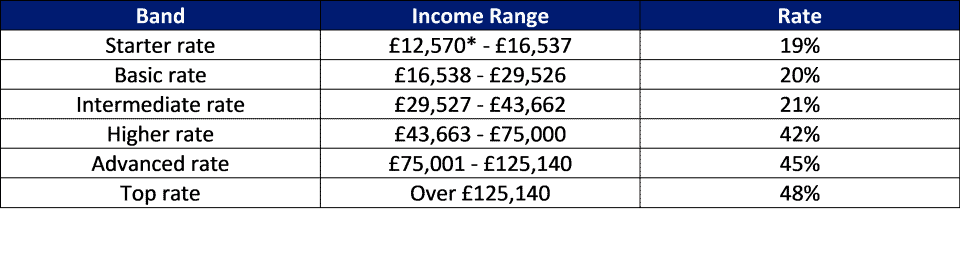
The Scottish Government has announced an increase of 7.4% in the basic and intermediate rate thresholds for income tax from April 2026. The Higher, Advanced and Top rate thresholds will remain unchanged.
Therefore, the Scottish income tax thresholds for the 2026/27 tax year will be:
Introduction of high-value council tax bands
The Scottish Government has announced that they will introduce new high-value Council Tax bands for the most expensive residential properties from 1st April 2028. Two new bands will be created above the current highest council tax band:
- Band I for properties valued between £1 million and £2 million; and
- Band J for properties valued above £2 million.
These bands will be based on up-to-date values for those properties only, with all other homes remaining on the existing Council Tax valuation framework.
Property income tax rates
The Scottish budget acknowledged the UKs plan to increase property income tax rates by 2% from April 2027. However, it did not confirm if Scotland will follow suit, noting the Scottish Government will gain powers to set its own separate rates from April 2027.
A reminder of the key announcements from the Autumn Budget 2025 can be found below.
Autumn Budget 2025: key information for Scotland
1. National Insurance (NI) relief on pension salary sacrifice limited to £2,000
The National Insurance Contribution (NIC) exemption for pension contributions through salary sacrifice will be limited to £2,000 a year. This means that both employees and employers will have to pay NI on any salary sacrifice over this amount. This will take affect from April 2029.
2. Changes to Enterprise Investment Scheme (EIS) & Venture Capital Trust (VCT)
The UK Government announced key changes to EIS and VCT rules which will be effective from April 2026. VCT income tax relief for investors will be reduced from 30% to 20%. Although an individual’s investment limits remain the same, the annual limit that an individual company can raise will increase to £10 million (£20 million for Knowledge Intensive Companies (KIC)), while the lifetime company limit will increase to £24 million (£40 million for KICs). The gross assets limit for qualifying companies will also rise to £30 million immediately before and £35 million immediately after the share issue. These increases do not apply to Northern Ireland‑registered companies trading in goods or electricity sectors, which will remain subject to the current limits.
3. Extend the freeze to National Insurance Contribution (NIC) and Inheritance Tax thresholds
The UK Government announced that the NIC thresholds for both employees and self-employed individuals will remain at their current tax levels for a further three years from April 2028 to April 2031. Inheritance tax (IHT) thresholds are also being extended by a further year, to April 2031.
Inheritance Tax planning is not regulated by the Financial Conduct Authority (FCA).
4. Changes to IHT on pensions rues for personal representatives
Personal representatives will be able to direct pension scheme administrators to withhold 50% of taxable benefits for up to 15 months and pay IHT due in certain circumstances. Personal representatives will be discharged from a liability for payment of Inheritance Tax on pensions discovered after they have received clearance from HMRC. This will take effect from 6 April 2027.
Inheritance Tax planning is not regulated by the Financial Conduct Authority (FCA).
5. Increase in dividend tax rates
The UK Government announced that the basic and upper rates of dividend tax will increase by 2%, whilst the additional rate will remain unchanged. The basic rate will rise from 8.75% to 10.75%, and the upper rate from 33.75% to 35.75%, effective from April 2026.
6. Increase in savings income
The UK Government announced that tax on savings income will increase by 2% across all bands. The basic rate will rise from 20% to 22%, the higher rate from 40% to 42%, and the additional rate from 45% to 47%. This change will also apply to chargeable event gains on investment bonds, which are taxed as savings income. This change will come into effect from April 2027.
7. Cut to Cash Individual Savings Account (ISA) Allowance
The UK Government announced that the full £20,000 ISA allowance will remain. However, from April 2027, the annual limit for cash ISAs will reduce to £12,000 for individuals under age 65, with the remaining £8,000 available exclusively for investment ISAs. Individuals aged 65 and over can still save the full £20,000 in cash ISAs.
8. Electric and plug-in hybrid mileage-based charge
The UK Government has proposed introducing a pay‑per‑mile tax on electric and plug-in hybrid vehicles, which will come into effect from 2028. Electric vehicles and plug-in hybrid drivers would be charged 3p per mile and 1.5p per mile retrospectively based on the distance they travel, although it is not yet certain how this will be enforced.
9. Fuel Duty
The UK Government announced an extension to the 5p fuel duty cut until the end of August 2026, with rates then gradually returning to March 2022 levels by April 2027. From April 2027, the Government has stated that fuel duty rates will be increased in line with RPI.
10. Agricultural Property and Business Property Relief
The UK Government announced in the Autumn Budget 2025 that the £1 million allowance for property qualifying for 100% business or agricultural property relief can be transferred to a surviving spouse or civil partner from April 2026. On 23 December 2025, the UK Government announced an increase to the proposed allowance from £1 million, to £2.5 million from April 2026.
Tax planning is not an activity which is regulated by the Financial Conduct Authority.
Notes and disclaimer
We have highlighted the most important changes that were announced during the Scottish and Autumn budgets, but we are aware that the UK and Scottish Governments also announced additional measures that might affect you.
Please note that this communication is intended for information only. It is not financial advice or a recommendation and should not be considered as such. If you have any questions or concerns on how the Budget will impact you or your circumstances, please contact your Financial Planner.