
ATTIVO
March 2025 Market Summary
The first quarter of 2025 has seen equity markets in the UK and Europe maintaining strong performance, while the US had its worse opening quarter since 2022. Notably technology stocks had their worst Q1 since the COVID-19 pandemic, while value stocks such as Unilever, defensive, and healthcare sectors rose. This further reinforces the principles that past performance does not guarantee future returns, and a well-diversified investment portfolio remains key to managing risks and capturing opportunities, rather than overexposure to a single sector.
Global Markets
Below shows how the some of the top indices around the world have performed in the last 12 months to 2 April 2025.
FTSE 100: 8.49%
S&P 500: 8.71%
Stoxx 600: 5.57%
Nikkei 225: -9.44%
So far in 2025, equity markets have experienced varying performance across regions, being heavily influenced by trade policy related uncertainty, in the form of President Trump’s higher US import tariffs and on-going trade disputes with most of its global partners. Many recent US indicators point towards a much weaker growth in the first quarter than previously expected, and US inflation expectations have increased.
The Federal Reserve is also to keep interest rates unchanged till the end of this year, after having previously looked to decrease interest rates gradually throughout 2025. Trump’s trade war is also affecting its closest neighbours, Canada and Mexico, with S&P Global now expecting negative real growth in both these countries this year.
Technology
The technology sector, previously a market leader, has underperformed amid apprehensions regarding costs, likely stoked by the release of China’s DeepSeek AI in February. However, market sentiment across the globe still favours the development of Artificial intelligence which is creating value in defence and healthcare stocks as those industries look to revolutionise using the new technology.
Defence stocks have also benefited from the EU’s ‘ReArm Europe’ plan, which promises a €150bn loan instrument to help European countries invest, as well as easing spending rules, which is expected to add €650bn to defence budgets by 2030.
UK
The UK equity market demonstrated resilience, with the FTSE 100 index showing modest gains. However, growth was tempered by broader economic challenges and fiscal policy adjustments. Notably, the UK government announced spending cuts amounting to £8.4 billion to adhere to fiscal rules, which had a measured impact on market sentiment.
European equities outperformed many counterparts, driven by favourable economic indicators and policy measures. The Euro Stoxx 50 index recorded a year-to-date increase of approximately 7.25% by the end of March 2025. Factors contributing to this growth included lower inflation rates, interest rate cuts by the European Central Bank, and fiscal stimulus initiatives, such as Germany’s €500 billion infrastructure package.
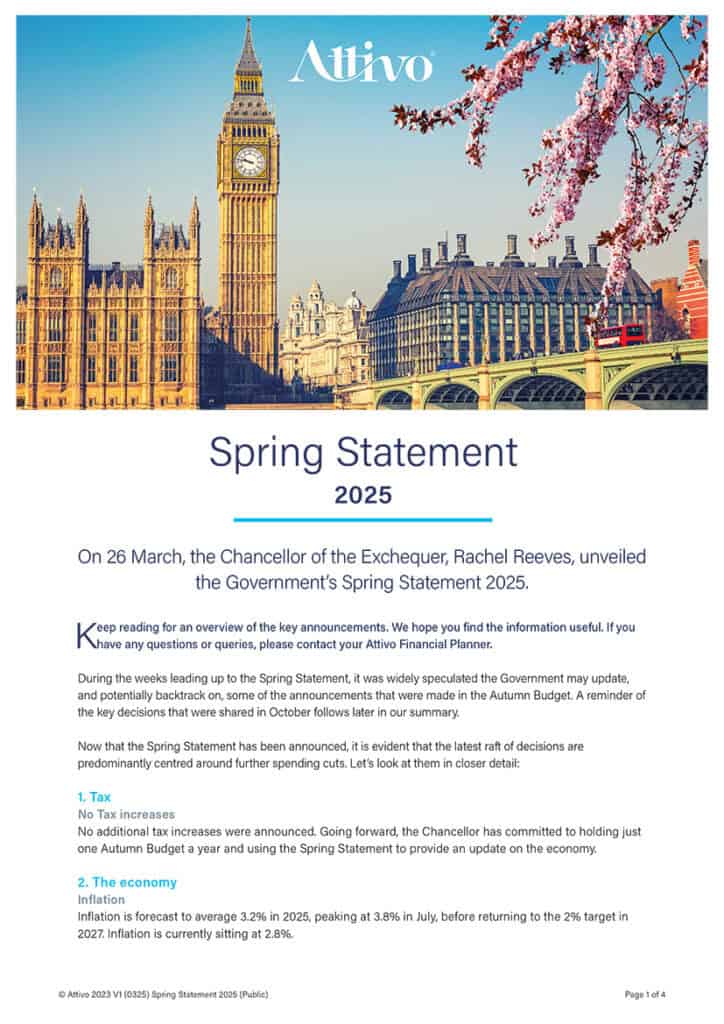
Spring Statement
The Chancellor announced UK growth expectations at the recent Spring Statement where the Office for Budget Responsibility (OBR) projected this years’ growth expectations to 1% this year. This is down from 2% previously forecasted, although the Chancellor did confirm that growth expectations had been upgraded by the Government for each subsequent year from 2026 to 2029.
Click image to read more information about this month’s Spring Statement 2025.
The key takeaways for this April are:
- In 2025 European and UK equity markets in 2025 have shown strong performance with the US not faring as well, indicating that the US may not dominate quite as strongly over the near term.
- Inflation remains sticky both sides of the Atlantic, with both UK and US hitting 3.7% and 2.8% respectively, year-on-year inflation between April 2024 and April 2025. The UK is expected to return to its inflation target of 2% in 2027.
- Chancellor Rachel Reeves delivered the UK’s Spring Statement on 26 March 2025. The statement did not introduce further tax increases but did introduce and explain the Governments fiscal cuts in welfare and civil service departments. We also saw the Government confirm foreign aid decreasing to finance the increase of defence spending which has risen to 2.5% GDP, the largest increase since the end of the cold war.
Do speak with your financial planner to discuss in further detail and ask any questions you may have.
This article is intended for information only. It is not financial advice or a recommendation and should not be considered as such. If you are unsure whether an investment is right for you, please seek independent financial advice. If you choose to invest, please remember the value of investments and any income derived from them can fall as well as rise and you may get back less than you put in.