ATTIVO
Knowledge share April 2025: Trump tariffs
Introduction
On 2 April, President Trump announced sweeping global tariffs, which triggered a significant downturn in global stock markets. Termed ‘Liberation Day’, the announcement introduced a 10% blanket tariff on all countries, alongside additional reciprocal tariffs for 60 nations. Despite being fully committed to implementing these tariffs, a week later, on 9 April, President Trump then announced a 90-day extension to the most severe tariffs, whilst also increasing the tariff on China to 125%.
What do tariffs mean for investors?
Due to the global nature of President Trump’s tariff announcements, the impact has been felt across markets around the world. It’s not just the US markets which have reacted negatively, the effects have also been felt in the UK, Europe and the Asian markets, such as Japan and China. With each announcement on whether tariffs will come in to force or not, markets have reacted with often large swings of volatility. For investment portfolios which are diversified globally and have holdings in each different market around the world, political events such as we are experiencing can have a drastic impact on their short-term value. This is an inherent risk in investing; it’s not something that can be avoided or minimised through diversification. However, it is important to note that even though a bleak picture is often being portrayed in the global markets, investing is not for the short term.
Using the MSCI World Index which provides a representation of global equity markets shown, Figure 1 shows how the recent tariff news had affected global markets, until Trump announced the 90 day extension where we have since seen them bounce back sharply.
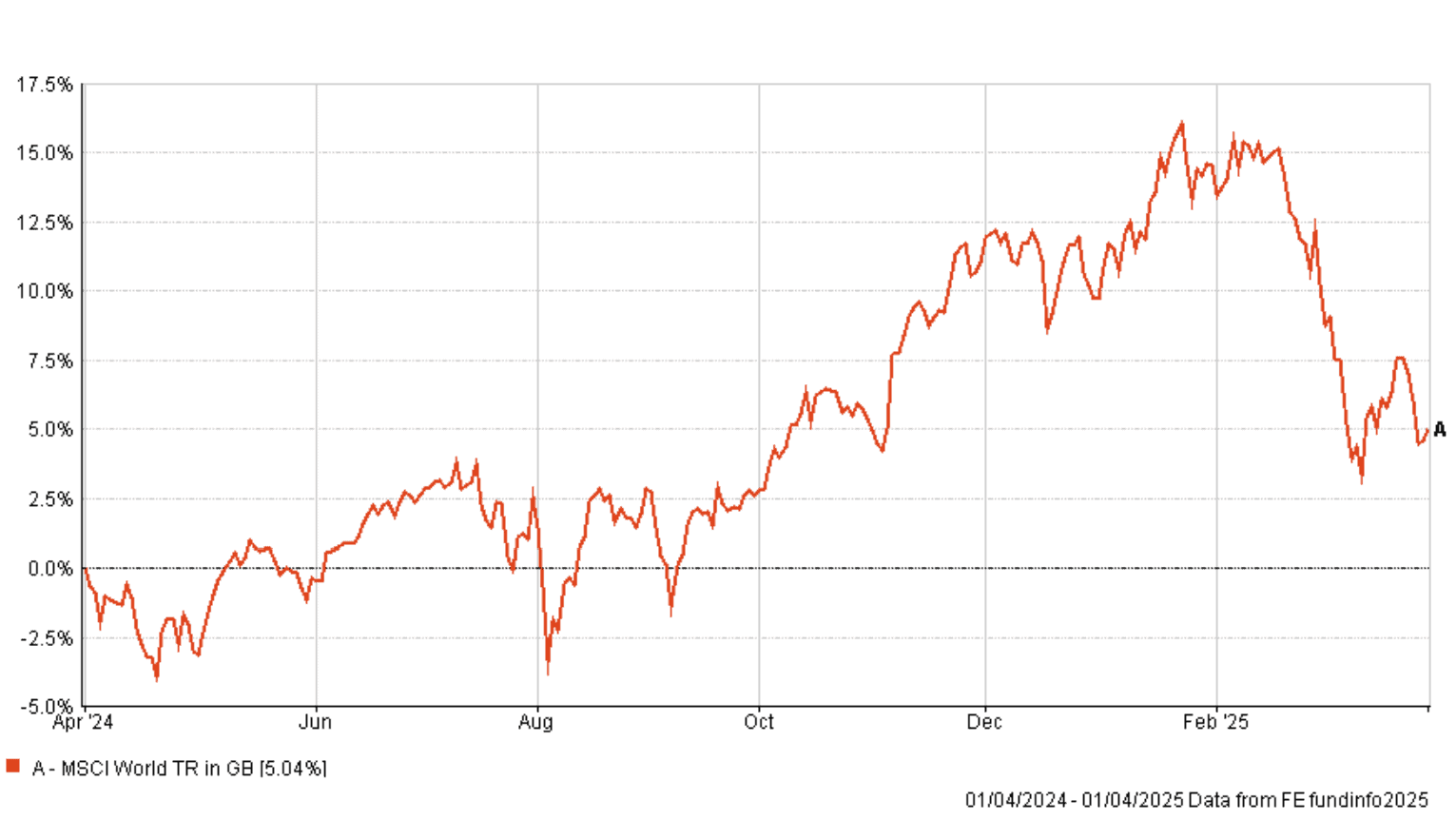
When looking very closely at market performance over the past year – a very short time span, it magnifies the effect of how an investment might have behaved during the recent announcement of tariffs, prior to the extension. As shown in Figure 1, a portfolio that invested at the beginning of April 2024 could have seen a 15% increase in value by February 2025, but instead only saw a 5% increase by April 2025.
This is an example of why investments are a long-term strategy, and trying to time or play the market over the short term may not be the most suitable. A typical investment horizon is for 5 years plus and so looking at a very close snapshot such as shown in Figure 1, can be misleading and lead to incorrect conclusions being drawn about the state of the market.
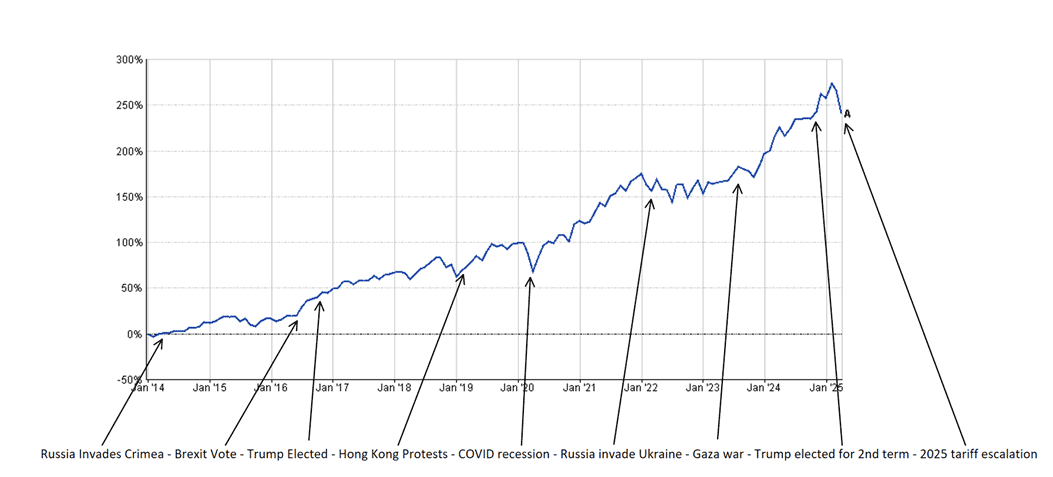
If we now look at a much longer time horizon, as shown in Figure 2, we can see how the same index has performed since 2014 up until the announcement of the extension to the implementation. Figure 2 also shows important and newsworthy events that were happening during the period and so provides some context as to how the markets were performing during market events.
Resilience plays a big part in how markets react to global trade disruptions. Over four years ago, the Ever Given container ship blocked the Suez Canal – a major event during the COVID-19 pandemic. Companies quickly adapted, re-routing through alternative ports to maintain trade.
This event caused global container costs to rise from $1,700 to over $10,000. In 2023, attacks in the canal reduced trade by 80%, where before 30% of the world’s shipping was reliant on this route. As a result, by 2025, container costs have dropped to around $2,000. This sharp recovery shows how the ability to adjust and stay flexible under pressure can shape outcomes, and reinforces the importance of resilience when considering the long-term impact of global events on markets.
The importance of staying the course
Events such as what we are experiencing now can cause distress to even the most experienced investors. Due to the constant 24 hour delivery of news, it can feel like there is no break from the constant reminders of the global events that are happening around us. It can therefore lead us to feel that we should take action within our investments, an almost ‘fight or flight’ response, and perhaps make a short-term change in the hope that the change will fare the storm better than current. However, these types of actions would be trying to time the market, and could lead to even further negative effects. With markets now rebounding, even if just for a short term, the importance of staying invested is highlighted.
This has been shown in many studies, including this example which shows that if you were to invest in a UK index fund from 2002 to 2023, but you had not been invested for the best 30 days in the market, this would have reduced your annualised return from 8.6% to 1.9% over the period (Brooks Macdonald, 2023).
In summary, market events like we are experiencing currently happen more frequently than you might expect or remember. It may lead you to consider making drastic changes to your investments or portfolios, but these short-term decisions can often be more harmful than beneficial. It is important to remember that markets are very resilient to change, and despite short term challenges, have always been able to recover and grow above their current level.
Sources:
Brooks Macdonald (2023) The importance of remaining invested, 7 December. Available at: https://www.brooksmacdonald.com/individuals/node/1017203 (Accessed: 7 April 2025).
This article is intended for information only. It is not financial advice or a recommendation and should not be considered as such. If you are unsure whether an investment is right for you, please seek independent financial advice. If you choose to invest, please remember the value of investments and any income derived from them can fall as well as rise and you may get back less than you put in.