
ATTIVO
Cut your taxes with these two proactive planning techniques
Cut your taxes with these two proactive planning techniques
Small, well‑timed decisions can make a significant difference to how much tax you pay over time.
With a proactive approach, it’s possible to protect more of your wealth and improve your overall financial position.
In this article, we explore two key areas where, with a bit of proactive planning, you can cut down on taxes and save more to spend on what matters most to you.
Here are two proactive planning techniques to help you cut down your taxes:
1. Maximise your ISAs and investments
ISAs are an effective ways to save money tax efficiently, as:
- There’s no tax on the interest you accumulate on any ISA – regardless of your income level.
- Any money held within an ISA grows free from UK tax, meaning there’s no income tax, Capital Gains Tax or dividend tax to pay on returns whilst in the ISA wrapper or when you draw on the funds.
- Tax never erodes returns inside an ISA. This means growth can compound more effectively year-on-year, thus leading to higher net outcomes than many non-ISA savings.
However, with upcoming changes to ISA rules, it’s more important than ever to review how your savings and investments are structured.
From April 2027, under 65s’ cash ISAs limits will be cut from £20,000 to £12,000. Should you choose to continue using your full ISA, allowance you’ll be obligated to use at least the remaining £8,000 for a Stocks & Shares ISA.
If you’re not using a Stocks & Shares ISA already, this route may therefore be worth exploring. In fact, it could even benefit you in the long run, as stocks and shares often lead to stronger returns and improved financial outcomes over time.
How can a Lifestyle Financial Planner help?
A Lifestyle Financial Panner can help you make sense of ISA allowance changes by reviewing your existing assets and identifying which are best placed within an ISA. By prioritising higher growth or income generating investments for tax efficient wrappers, you can make better use of the allowances available to you.
Have you found this helpful so far?
Download our guide for a complete list of tax planning tips:

2. Plan for your pension
Pensions remain one of the most powerful tools for reducing tax. This is driven by pension tax relief, which refunds a portion of the income tax you’ve paid on the money you contribute.
For most personal and workplace pensions, basic‑rate tax relief (20%) is added automatically by HMRC to your pension, known as relief at source. If you pay tax at a higher rate, you can then claim additional relief back via your tax return or directly from HMRC.
Below is an example for a higher rate taxpayer:
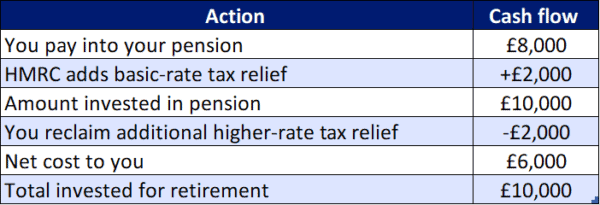
In this example, a £10,000 pension contribution ultimately costs a higher‑rate taxpayer just £6,000, once all tax relief has been claimed.
This makes pensions especially valuable for higher earners, as contributions are relieved at your highest marginal rate. Additionally, employer pension contributions don’t count as taxable income, don’t incur employee National Insurance and still benefit from full pension tax treatment.
What’s more, you can make the most of carry forward, enabling you to access up to three years of unused allowance. This creates an opportunity to make substantial, tax‑efficient contributions in your high‑earning years. In some cases, this can allow contributions of up to £220,000, significantly reducing your taxable income while strengthening your long‑term retirement provision.
Additionally, any growth within your pension is free from all UK tax.
However, it’s important for high earners to note that they are likely to be impacted by the tapered annual allowance. While the standard annual allowance is £60,000, this can reduce to as little as £10,000 once your income exceeds £260,000. This means that careful planning is essential to avoid unexpected tax charges.
How can a Lifestyle Financial Planner help?
A Lifestyle Financial Planner will help you navigate these complexities by reviewing your pension contribution history, identifying unused allowances and building a tailored contribution strategy.
They’ll ensure your pension savings are maximised safely, while remaining within current limits and aligned to your wider retirement goals.
They can also help identify opportunities to consolidate existing pensions, simplifying management, reducing fees and ensuring your retirement savings are working as efficiently as possible.
Looking for more helpful tips to cut your taxes?
A high earner’s guide to smarter tax planning, written by Attivo’s financial planning experts, explores the above planning techniques and more; from how to protect your personal allowance to tactics on managing and minimising capital gains tax on investments – and beyond.
This content is for informational purposes only and should not be construed as financial advice or a recommendation. Investments may fall as well as rise, and you may not get back the amount originally invested. Some investments such as AIM shares or BR investments carry more risks and exhibit higher volatility and reduced liquidity. If you are unsure whether an investment is right for you, please seek independent financial advice. Attivo Financial Ltd (FRN 497130 is authorised and regulated by the Financial Conduct Authority (FCA) for the provision of regulated financial advice.