
ATTIVO
Call Of The Wild
By Lebby Eyres
Journalist Lebby Eyres explains the motivation behind taking on the World’s Toughest Row – crossing the Atlantic.
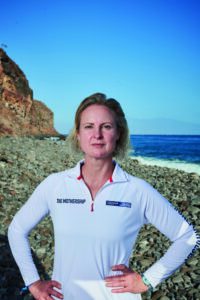
When my mum June died in 2008, I struggled with my grief. But with two young kids, an ailing father and a full-time job as a magazine editor, I had precious little time to myself to try to process this. Perhaps there aren’t many people who’d decide that walking a marathon would be the ideal solution, but that’s what I did.
Signing up for the Moonwalk, a 26.2-mile midnight hike around London, I trained by pounding the streets, working through my thoughts at the same time. As Mum had died of breast cancer, it was hugely cathartic to cross the finish line having raised around £4,000 for charity.
This became a pattern: when Dad died of pneumonia in 2013, I took part in the London Marathon for the British Lung Foundation, and when a toddler died on our street, I did it for Great Ormond Street Hospital.
Donation Fatigue
But after a while, I worried people would tire of sponsoring me and physically my body had become used to marathons. My adrenalin levels and the bank account of a charity somewhere needed a boost. I wanted a new challenge, one that would push me further and be so astonishing it would get my nearest and dearest reaching into their pockets once again.
Atlantic Antics
In December 2020, a friend and fellow Oxford rowing Blue, Jo Blackshaw, called to say she was taking part in the Talisker Whisky Atlantic Challenge, and there was a seat in the boat available. Dubbed the World’s Toughest Row, the race takes place annually and is open to solos, pairs, trios, fours and the odd five.
It attracts people from all walks of life, but the barrier to entry is that costs are high. In total, a crossing might cost around £120,000. As well as race fees, every electrical item has to have a manual back-up in case of disaster, and the cost of the dehydrated food alone runs to thousands. And that’s before you’ve raided the biscuit and protein bar aisle at Waitrose.
Securing Sponsors
Before I’d even had time to mull over Jo’s offer, another woman had stepped forward, and I thought my chance was gone. But fate was to hand me another. One Saturday night in May 2021, as I was sitting nursing a glass of wine in the back garden, the phone rang.
“Paula can’t take part,” Jo said. “We don’t want to go as a trio and we’d love you to do it!”
I hesitated, worried about seasickness, but my husband was determined I should do it. “You’ll regret it for the rest of your life if you don’t,” he immediately said to me. After a weekend spent on board, I agreed – I loved boat life and being on the water – and as a masters rower already, I was fit enough.
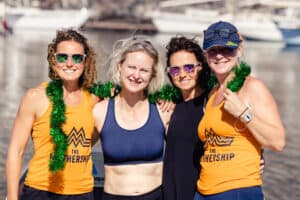
Luckily for me, sponsorship was also secured, as Jo’s employer Tritax Big Box generously stepped up, as had British Gas for our crewmate Felicity Ashley, plus we had some philanthropic mentors behind us. Other crews in our fleet of 36 were self-funded – often middle-aged self-made millionaires looking for ways to push themselves and make a difference. But there were many young female teams who raised funds by putting on events.
Start Line Stress
It’s not for nothing that the organisers of TWAC say that half the battle of the race is getting to the start line. In the run-up, we had last-minute dramas with our boat’s electrical system, I had a bone cancer scare which happily resulted in an all-clear, and then my crewmate got Covid.
The relief when we set off amid cheers and toots of boat horns from La Gomera on 12 December was huge. For the first few nights, we could still see the navigation lights of crews around us, and in the cool of those moonlit evenings we’d try to race them. It was surreal. Our bodies were sore and aching, our minds deranged from lack of sleep but the novelty of the experience was such a thrill to us all. Seasickness barely troubled us.
The Going Gets Tough
Eventually, the real grind set in. The calm seas off the coast of Africa gave way to choppier waters as we turned towards our eventual destination of Antigua. As the wind picked up, so did the danger. Everything becomes riskier, from moving around the boat to simply going to the loo. No-one thanked me when I failed to adequately “bucket and chuck it” one night in the waves.
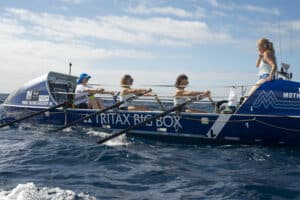
Although it felt like we came perilously close to capsize at times, our boat, Mrs Nelson, held firm. It was more mundane issues that threatened to tip us over the edge, metaphorically if not literally. Sore bottoms, stiff hands and, most unexpectedly, shingles, were my main medical issues.
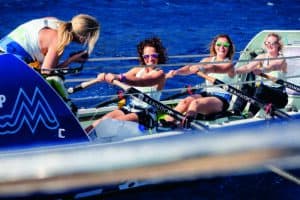
Mentally, as the endless weeks stretched on, we started to long for land. We got wrapped up in one of the tightest races the event has ever seen, as we battled the younger female four, One Ocean Crew, across the sea. At one point, I cracked, sobbing down the phone to race control and shutting the cabin door against the waves.
Grand Total
The knowledge we were doing this to make a difference to others was all-important. Our three charities were the bomb disposal charity the Felix Fund – chosen because we’d inherited the boat from our skipper’s husband, who rowed TWAC as the Felix Five; the Noah’s Ark Children’s Hospice, as Felicity had a colleague whose child was treated there, and Women in Sport.
All of us had been inspired by sport and wanted to show women and girls that motherhood doesn’t mean an end to a sporting life.
We raised £70,000, so now, someone who has lost a leg defusing a bomb may get a new stairlift. A child with terminal cancer will spend precious time with their family in beautiful surroundings. Women may think, “Perhaps endurance sports are for me.”
Now, over 250 women have rowed an ocean. We’d like it to be more. Our practical training made us more hands-on and at the age of 50, it was empowering to pick up new skills.
As a fleet, we’ll have raised millions. The pride on the finish line when Carsten Heron, race CEO, read out our total of £70k, was huge. Our heads were spinning and we were struggling to adapt to solid ground but we were euphoric. Our pride in what we’d achieved knew no bounds.
Family First
Best of all, it’s made a huge difference to family life, for all of us. Seeing your mum succeed in a traditionally male-dominated sport has been inspiring for all 11 of our children. Both my kids, Ines and Vincent, are rowing, perhaps with one eye on crossing an ocean in the future.
And it’s turned me into more of an adventurer. Since I’ve been back, I’ve abseiled the Tête de Chien on the Côte d’Azur, and taken part in a world-record breaking all-female rope climb up the Breithorn, for Swiss Tourism’s 100% Women campaign. That challenged me in a new way – I feel secure on water, but heights are another matter. Nowadays however, I have no hesitation – I simply take a deep breath and carry on.
So many people ask me what’s next. The thing about rowing an ocean is that part of your soul forever stays connected to the sea. I long for the open water and the waves, so the Pacific race could beckon one day. But in the meantime, I’ll continue to search for my next fundraising challenge.
The question is, how do I top this one?

Five action packed ways to raise money for charity in 2024
If you’ve been inspired by Lebby’s fund-raising exploits but want to start with something slightly less epic, read on…
- If you love the sun, imagine what it’s like running several back-to-back marathons in it. The six-day Marathon Des Sables is the “toughest footrace on earth” and takes place in April 2023 in Morocco.
- Less hot and without the inconvenience of sand dunes, the 4Days Marches in the Netherlands are a wonderful multi-cultural event. They take place in the third week of July, and participants walk 30, 40 or 50km a day from and to Nijmegen.
- A drunken bet that somehow turned into a sporting phenomenon: the Ötillö swimrun originated in Sweden and races now take place in several natural locations around the world, including Cannes, Malta, and the Isles of Scilly. Teams of two swim and run alternately non-stop.
- The Big Battlefield Bike Ride takes place in northern France and raises money for Help for Heroes. Next June, you can join other cyclists pedalling from Etretat to Dunkirk, stopping off at significant sites from both World Wars along the way, including Ypres and Dieppe. Min £3K fundraising required.
- If you can’t quite stomach the thought of crossing the Atlantic, why not take part in the Great River Race? This challenge, which usually takes place in September, involves crews racing from Millwall to Richmond in fixed seat boats. Craft are many and varied.
If you’d like to explore your options for financial planning, why not talk to Attivo? Our team of Chartered Financial Planners happy to help to make the process a smooth one. Call us on 01242 585444 or Clientservices@Attivo.co.uk.